
Belle Pente
Belle Pente wines hold a special place
in our thoughts, here at Avalon Wine. Since owners Jill and Brian O'Donnell
sold their first wines in 1996, we've enjoyed their combination of reasonably
priced, carefully cellared Pinot noirs and white wines, made with Brian's
unique vision. Now that their Estate vineyard (Belle Pente Vineyard)
is producing great fruit, the wines are even more satisfying. Brian quietly,
with little fanfare, makes delicious and intricately nuanced, Burgundy
inspired Pinot noirs. His white wines provide the clean, fresh scents
and flavors of Alsacian and German wines. Each year, Belle Pente's reasonably
priced wines get better, with increasing depth of scents and flavors.
Brian and Jill O'Donnell were Silicon Valley
executives when the Loma Prieta Earthquake (1989) provoked a resolution
to transition from high tech to wine. They moved to the Willamette Valley
in 1992 and planted their vineyard in 1994. First wines were produced
in 1996.
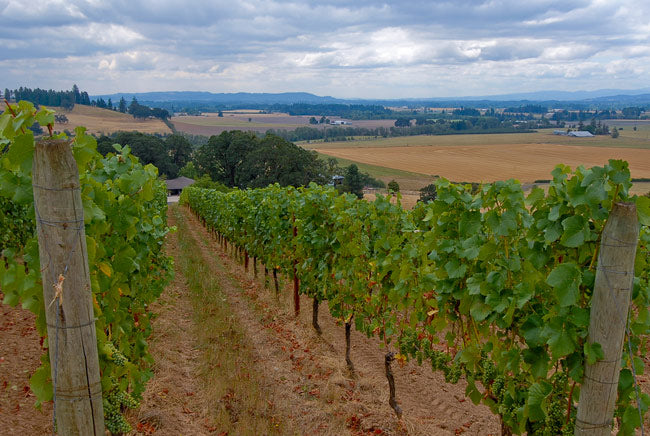
Belle Pente's 70 acre property
is on one of the oldest farms in Yamhill County. The vineyard
site rises from 240' to 500' with south, south-east, and south-west
exposures. The first vineyard was planted in 1994, and now includes
16 acres of Pinot Noir, Pinot Gris, and Chardonnay. They also lease
seven acres of old vine Pinot
Noir at Murto Vineyard (est. 1978) in the Red Hills of Dundee. A
wine made from Wahle Vineyard fruit is also made.
About Belle Pente Vineyard and Winery
by Cole Danehower
"We're
trying to make the best limited production, family-domaine scale wines in
Oregon," explains Brian. "We don't want to be big, we like
being small. We're almost at our capacity, and now we're going to focus
like crazy on quality."
The
O'Donnells' inspiration is clearly Old World-down to the ambiance implicit
in their name. "Since everyone who has ever visited our place comments
on how beautiful it is, the 'Belle' part was easy," explains Brian. "We
discovered 'Pente' during a visit to Alsace, where we found the word
was often used to describe the steep slopes of some of the Grand Cru
vineyards. Since parts of our hillside are quite steep, it seemed like
a natural fit."
Brian started as a home
winemaker in the 1970s, and by the end of the 1980s had decided to elevate
his craft from hobby to vocation. In the early 1990s Brian had a job
opportunity in the Portland area, and after visiting the Willamette Valley
wine country and tasting the wines "we
said 'This is it!'"
Brian and Jill purchased the land that was to become Belle Pente Wine
Cellars in 1992. "From a vineyard standpoint, we felt it had great potential," recalls
Brian. "The elevation was right, ranging from 200 to 500-ft, with
all WillaKenzie soils and great sun exposure-some of the best in the area."
In 1994 Brian and Jill planted the first part of Belle Pente's estate vineyard
with Pinot noir, Gamay noir, Pinot blanc, Pinot gris, and Chardonnay
"I believe that what will distinguish Belle Pente
is the quality of our site," says Brian. "This site is very
special. In 1997 and 1998 we made small quantities of wine from the estate
vineyards and they were superb." The Belle Pente Estate Vineyard
reaches marketable production levels with the 2000 vintage.
Belle Pente's first harvest was in 1996, but until recently the bulk
of the wine Brian has been making has come from purchased fruit, primarily
from Murto, Wahle, and Maresh vineyards.
The winery's capacity is about 4,000 cases, which is just where
Brian wants to be-"We don't want to be big," he says
flatly.
Approximately half the production is Pinot noir, 30 percent Pinot gris,
and 10 percent each Chardonnay and Riesling.
Brian's approach to his Pinot noir is clearly Burgundy-inspired: "We
don't do a whole lot; we basically let them make themselves." While
this is certainly true, like any good winemaker, Brian makes many different
decisions that affect the final style and quality of his wines.
For instance, his Pinot noir grapes are picked early in the morning so
they arrive at the winery cool. The fruit is carefully sorted to remove
any rot and mildew, and is 100% destemmed. Long cold soaking, long low
temperature fermentations using native yeast, and pressing at dryness
directly into barrel, are examples of how Brian tries to preserve the
character of the fruit.
Bell Pente's Pinot noirs generally come in two styles, a Willamette Valley
blend and single-vineyard Reserves (including Wahle, Murto, and in 2000,
Estate). The Willamette Valley spends a year in oak, 25 percent of which
is new. The Reserve spends longer, 18 months, and has a higher proportion
of new oak-between 30 and 40 percent.
"We want to make Pinot noir wines that have great length and texture,
but a little bit lighter in style and not heavily extracted," says Brian
of his stylistic approach. "We're not looking for wines that will keep
20 years. We want our wines to be approachable upon release, and hit their
peak within a 5-7 year window, depending upon the vintage."

Jill & Brian
O'Donnell at IPNC, July 2003
One aspect that sets Belle Pente apart from the "Pinot pack" is
their enthusiasm and focus on white wines.
"A lot of people ask why we make so many white wines," chuckles Brian-"because
it's fun!" Besides, adds Jill, "It's not as if you can just start
growing another red grape here that is as wonderful as Pinot noir; yet there
are a lot of great white varieties that make excellent wines here."
Belle Pente makes Chardonnay, Pinot gris, and Riesling, as
well as a new rosé. "With our whites," says Brian, "we're
looking to squeeze all the intensity we can; we want them to be big and
rich, but with good acidity. Alsace is the stylistic model for our white
wines."
For their Chardonnay, Brian approaches things differently than
the Pinot noir. "I find the white wines require more intervention," he
says. "Stylistically, we're looking for fairly big, rich, and ripe
fruit-the best of California-style and Burgundy-style."
To help achieve that, Brian barrel ferments his Chardonnay
and inoculates with selected yeast; "I've had too many white wines get funky with
indigenous yeasts," he comments.
He also is not shy about leaving a barely perceptible amount
of residual sugar, and having a relatively high alcohol content. "The wines
have enough acidity for the sugar to bring out the fruit, and the alcohol
gives the wines more body and greater length," he says.
The Chardonnay typically stays in barrel for a full year. The
barrels are 50 percent French and 50 percent Oregon oak. "The reserve will
have more new oak and be a richer, fuller, more Californian style," says
Brian. "Our regular Chardonnay tends to be a little leaner, more
of a Mâcon style."
Belle Pente's Estate vineyard contains mixed Dijon Clone vines, though
it is too early to know just what the final character of the grapes will
be. Brian plans to blend some Clone 108, as he did in 1998, to add a
little bigger body to the wine.
Brian is excited about Pinot gris and Riesling, in particular. "I'm
really bullish on Pinot gris. We barely knew what it was when we came
here, but we made a few carboys in somebody's garage in Portland and
became a fan of the varietal overnight."
Brian wants his Pinot gris to be in an Alsace style, with as much bigness,
ripeness, and richness as he can get while still maintaining good acidity.
Belle Pente's Pinot gris fruit comes primarily from two vineyards. Brian
likes the combination of flavors he gets from the tropical character
of Wahle Vineyard fruit complemented by the spiciness from Whistling
Ridge Vineyard.
"We'll take what the vintage gives us in terms of dryness or sweetness,
and we'll try to get as much ripeness and richness as we can," says Brian.
Belle Pente's Riesling is made in small quantities from 15-year
old vines. "I
love to make it, I love to drink it, and I love to sell it," enthuses
Brian. "Riesling is a noble grape, and Oregon has a lot of it planted,
but much of it goes into $6 supermarket wines-We're trying to make a
serious Oregon Reisling; completely dry, high acidity, good flavor."
In fact, that could be Belle Pente's byword: serious. With a distinctive
and varied white wine program, an Estate Pinot noir vineyard only beginning
to exhibit its character, and a focus on quality, Brian and Jill O'Donnell
clearly take their winemaking mission seriously.
The Vineyards
Founded in 1997, the winery's Estate vineyard is now at
16 acres and the new Pinot noir blocks planted in 98 will yield their
first fruit this year (2000). The winery also leases the 11 acre Murto
Vineyard and increased overall production to about 3000 cases in 2000. Murto
Vineyard - Red Hills of Dundee - Source for reserve-level Pinot Noir
since 1996. Leased & farmed by us since the 2000 vintage.
Wahle Vineyard - Yamhill-Carlton District - Source
for Pinot Gris since 1996, Pinot Noir since 1997 (including reserve-level
since 1998), and Chardonnay from 1997 through 2000.
Maresh Vineyard - Red Hills of Dundee - Source for
reserve-level Chardonnay in 1997 and 1998, and Pinot Noir in 1997, 1998,
1999, and 2001.
Whistling Ridge - Ribbon Ridge - Source for Pinot Gris
since 1996, and Chardonnay from 1997 through 1999.
Yamhill Vineyards - Yamhill-Carlton District - Source
for Riesling since 1998, and Chardonnay in 2001.
|
|